With every year electric vehicles earn bigger market shares in the new car market in Europe and in the rest of the world. Development of technologies, government subsidies and environment concerns are the main reasons why more and more customers choose electric vehicles. Do we follow worldwide trends in Latvia?

According to European Alternative Fuels Observatory (EAFO) data, in first 8 months of 2016 electric vehicles had a 1,1% market share in the new car market. In Latvia this number is 0,29%, which equals 29 units. The absolute leader in Europe is Norway with 28%. Norway’s government has led various support programs since 1990 to stimulate no emission vehicles.

There are several benefits for electric vehicle users and owners in Latvia – no first registration fee, no annual vehicle’s exploitation tax, lower tax fee for establishments, also electric vehicles can use bus lanes and have a free parking in Rīga and Liepāja cities. 

“Those incentives are good for motivating electric vehicle users. You can save up to 300-400 euros per month using the car intensively,” says Arnis Bergs, “No emission mobility support society” chairman of the board of Latvian organisation, No Emission Mobility Support Society The organisation’s goal is to promote development of sustainable, emission free transport. 

The infrastructure of electric vehicles is as crucial as government’s support. There are 5 quick charge stations in Latvia that allow the vehicle to be fully charged in 30 minutes. Three of those stations are located in Riga, one in Gulbene and one in Ogre. Riga and Jurmala have 11 charging points together, which is not enough to use electric vehicles effectively.

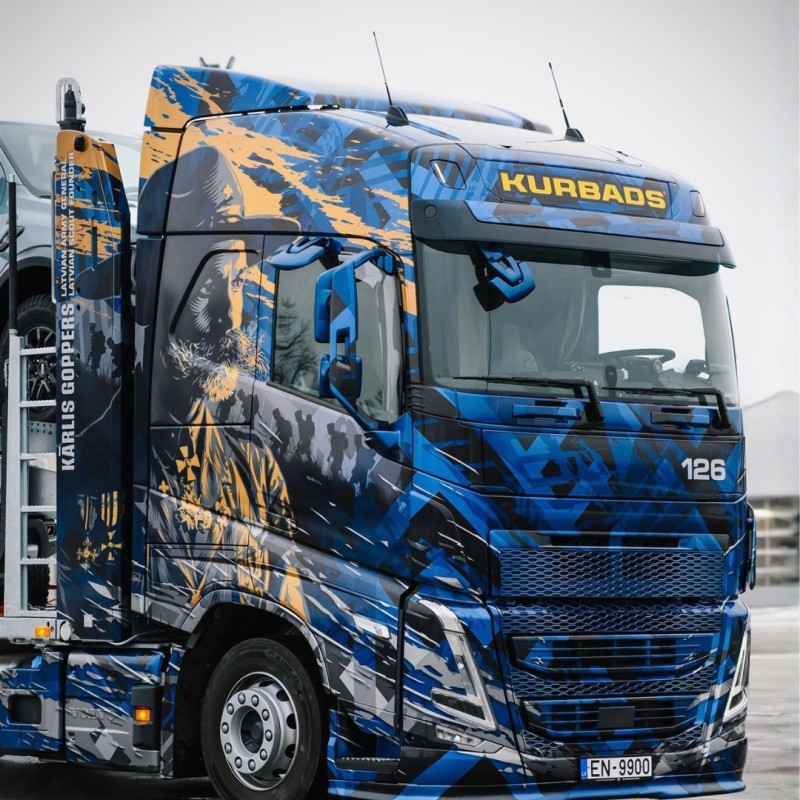
295 electric vehicles in total are registered in Latvia. Only 29 of them were registered this year. “While we don’t have decent infrastructure and government’s support for purchasing, we will have this kind of a number every year,” says Toms Hartmanis, “Kurbads” logistics manager in the Baltic States.

In 2014 when Latvia sold emission quotas and gathered funding to decrease CO2 emissions, a true electric vehicle boom happened/took place?. Municipalities had 85% subsidies, while establishments had 50% subsidies from full price of electric vehicles. 176 new electric vehicles reduced the average amount of emissions by 2%.

Toms Hartmanis: “Electric vehicles are a tiny part of total car amount handled by our company. Most often we transport Nissan “Leaf” cars to different presentations in the Baltic States, promoting interest in electric vehicles.” Toms thinks that biggest flaw of the electric vehicles’ is their short range: “In reality the maximum range in combined conditions is 160 km. That is not enough to go from Riga to Ventspils.”

Arnis Bergs disagrees with this opinion: “Electric vehicles are indeed effective in cities and close to them. For example, in Estonia there are 50 electric taxis. Also in Riga they are getting more popular.”

13 years is the average age of the cars in Latvia, including a large share of diesel engines and SUVs. It is very important to significantly reduce the CO2 emissions because in 2030 this parameter has to be at the 2005 level. Charges will be applied for exceeding the quota.

“European Union’s new regulations have forced our government to do something. But we need to make active decisions now. First step is to reach the goals of 2020. We have to have 10% of total cars to work with renewable fuel. Also the new combustion engines must have CO2 emissions lower than 95g/km. Today, in 2016 this parameter is around 130g/km,” task for not so distant future is clear for Arnis Bergs.

According to data provided by “Auto Asociācija”, to achieve this parameter, we must have 5000 electric vehicles by 2020. Also the Ministry of Transport demands support from government funds, so in 2017 it could co-finance 7000 euro for purchasing of new electric vehicles. 5000 and 3000 euro in 2018 and 2019 respectively.

Arnis Bergs regards that the biggest challenge is to integrate the problem of CO2 emissions in political and economical decisions of the government. It is a factor of economics and health, as 10% electric cars on the roads leads to lower fuel import by 50 million euros and also a much cleaner air in the city. But the main factor is to show EU that we tend to solve the problem.

Can we wait for a new electric vehicle boom in 2017?


Image modal


Privacy policy

1. Introduction

SIA “KURBADS UN KO” (hereinafter – the Controller), through the website www.kurbads.lv (hereinafter – the Website), processes personal data obtained from the data subject – the Website user (hereinafter – the User).
The Controller respects the User’s privacy and personal data protection, observing the User’s rights to lawful processing of personal data in accordance with the applicable legislation – Regulation (EU) 2016/679 of the European Parliament and of the Council of 27 April 2016 on the protection of natural persons with regard to the processing of personal data and on the free movement of such data (the Regulation), and other applicable legal acts in the field of privacy and data processing.
Considering the above, the Controller has developed this Privacy Policy with the aim of providing the User with the information specified in the Regulation.
This Privacy Policy applies to data processing regardless of the form and/or medium in which the User provides personal data (via the Website, in paper form, in person, or by phone).
The Controller reserves the right to amend these terms at any time. It is the responsibility of the Website visitor to independently check the Website content to be informed about any changes to the terms.

2. Controller’s identity and contact details

The Controller is SIA “KURBADS UN KO”, VAT registration No. LV50003264331.
Address: Mazjumpravas iela 24, Riga, LV-1063
Website: www.kurbads.lv
E-mail: kurbads@kurbads.lv
Phone: +371 67803311

3. Purposes and legal basis for processing personal data

If the User provides their personal data to the Controller by phone, via Website contact forms, by e-mail or postal mail, we store and use this information to fulfil or conclude a relevant service contract, including: customer identification; contract preparation and conclusion; provision of services (fulfilment of contractual obligations); customer service; handling and processing complaints; enhancing customer loyalty; administration of payments and settlements; debt recovery and collection; proof of facts; website maintenance and improvement; business planning and analytics; planning and record-keeping. We also process such data for providing information to public authorities and operational entities in cases and to the extent specified in external regulatory enactments.
The legal basis for data processing includes: conclusion and execution of a contract, compliance with legal obligations, the Client’s (data subject’s) consent, and our legitimate interests (for example, to verify the Client’s identity before concluding a contract; to ensure the fulfilment of contractual obligations; to analyse Website usage; to ensure service efficiency, etc.).

4. Categories of personal data

Categories of personal data: name, surname, personal identification number, e-mail or postal address, IP address, phone number, content of a message or letter, etc.

5. Categories of personal data recipients

Data is disclosed to those Controller’s employees who require it to perform their direct duties in order to fulfil or conclude a relevant service contract.
When obtaining and using personal data, we partially use the services of external service providers who, under contract, strictly follow our instructions and whom we check both before using their services and continuously thereafter.

6. Categories of data subjects

Categories of data subjects: current, former, and potential clients of the Controller, as well as other persons who express a desire to contact the Controller.

7. Transfer of data outside Latvia

The received data is not intended to be transferred outside Latvia, the European Union, or the European Economic Area, nor will it be transferred to any international organisation. However, given that the Website is linked to Google and Facebook services, the Controller cannot guarantee that these companies will not transfer data outside the EU or EEA.

8. Data retention period

We process and store the User’s personal data for as long as either party has a legal obligation to retain the data.
After the specified circumstances end, and unless otherwise stated in the data protection provisions, we delete personal data no later than three months after the original reason for data retention no longer applies, except where we have a legal obligation to continue storing the data (for example, but not limited to, for accounting or litigation purposes).

9. Data subject’s access to personal data

The data subject has the right to access their personal data within one month from the date of submitting a relevant request.
The User may submit a request to exercise their rights in writing in person at the Controller’s legal address (presenting an identity document), by post, or by e-mail signed with a secure electronic signature.
Upon receiving the User’s request to exercise their rights, the Controller will verify the User’s identity, review the request, and fulfil it in accordance with legal requirements.
The User has the right to receive the information specified in legal acts regarding their data processing, to request access to their personal data, as well as to request the Controller to supplement, correct, or delete such data, to restrict processing, or to object to processing, insofar as these rights do not conflict with the purpose of the processing (contract conclusion or fulfilment).
The data subject is not entitled to receive information if its disclosure is prohibited by law in the interests of national security, defense, public safety, criminal law, or to protect the State’s financial interests in tax matters or for financial market supervision and macroeconomic analysis.

10. Cookie processing

The Website collects data about its visitors to allow the Website operator to assess the usefulness of the Website and how it could be improved.
The Controller continuously improves the Website to enhance its usability and therefore needs to know what information is important to visitors, how often they visit, what devices and browsers they use, the regions they come from, and which content they prefer.
The Controller uses Google Analytics to analyse how visitors use the Website. Information on how Google Analytics works can be found at https://support.google.com/analytics/answer/1012034?hl=en&ref_topic=6157800. We process collected data in our legitimate interest to better understand visitor needs and improve access to our published information. Visitors can opt out of data collection by Google Analytics as described here: https://tools.google.com/dlpage/gaoptout/.
The server hosting the Website may log requests sent by the visitor (device used, browser, IP address, date, and time of access). Such data is used for technical purposes: ensuring proper functioning and security of the Website and investigating possible security incidents. The legal basis for collecting such data is the Controller’s legitimate interest in ensuring the technical availability and integrity of the Website.
Cookies are small files stored on a visitor’s computer each time they visit the Website, as determined by the visitor’s browser settings. Some cookies are used to tailor and personalise content and advertising for the visitor, based on content they have previously viewed, thus making the Website easier and more convenient to use. More information about cookies and how to delete or manage them can be found at www.aboutcookies.org.
The Website uses cookies to collect the user’s IP address and browsing information and to remember visitor preferences. Cookies allow the Controller to track Website traffic and user interaction with the Website, which we use to analyse visitor behaviour and improve the Website. The legal basis for using cookies is the Controller’s legitimate interest in ensuring Website functionality, accessibility, and integrity.
Visitors can control and/or delete cookies at their discretion. More information is available at www.aboutcookies.org. Visitors can delete all cookies on their computer, and most browsers can be set to block cookies. Visitors can refuse cookies in their browser settings or at https://tools.google.com/dlpage/gaoptout. Blocking cookies may require visitors to manually adjust settings each time they visit the Website, and some services or functions may not work.
Statistical data about Website visitors is accessible only to those Controller’s employees responsible for analysing such data.
Unless otherwise stated, cookies are stored until the action for which they were collected is completed, and then they are deleted.
If the Website offers a forum or comment section, the visitor’s IP address and data provided by the visitor are stored. Cookies containing such data may be stored for one year for convenience (so the visitor does not have to re-enter it each time).

Provider

Cookie name

Purpose

Storage period

Google Analytics

_ga

Used to identify unique website visitors by assigning a randomly generated identifier (“Google Universal Analytics” cookie)

2 years from creation

Google Analytics

_gid

Used to identify unique website visitors (“Google Universal Analytics” cookie)

24 hours from creation

Google Analytics

_gat_UA-39952253-1

Used to reduce the amount of data recorded by Google when there is a high volume of users on the website (“Google Universal Analytics” cookie)

1 minute from creation


11. Third-party websites

We may cooperate with third parties authorised to place third-party cookies on our websites or in our services, applications, and tools with your consent. These service providers enable us to provide you with a better, faster, and safer website experience. Note that third-party cookies are subject to the third parties’ privacy policies, and we take no responsibility for these privacy policies.
The Website uses the “Facebook Pixel” tool. The purpose of using this tool is to personalise content and advertising for Facebook users. To learn more about Facebook’s privacy policy, click here: https://www.facebook.com/about/privacy/. You can also change your advertising settings in your Facebook profile.

12. Right to lodge a complaint with a supervisory authority

The data subject has the right to lodge a complaint with the supervisory authority – the Data State Inspectorate.
Documents may be submitted to the Data State Inspectorate by post, by e-mail (documents signed with a secure electronic signature), or by leaving them in the mailbox on the 1st floor at Blaumaņa iela 11/13, Riga. E-mails may be sent to: info@dvi.gov.lv.

13. Validity of the Privacy Policy

We reserve the right to amend and supplement the content of this Privacy Policy from time to time to clarify the description of how we process your data.
Therefore, we encourage you to review this Privacy Policy regularly to stay informed about the processing of your personal data on the Website.